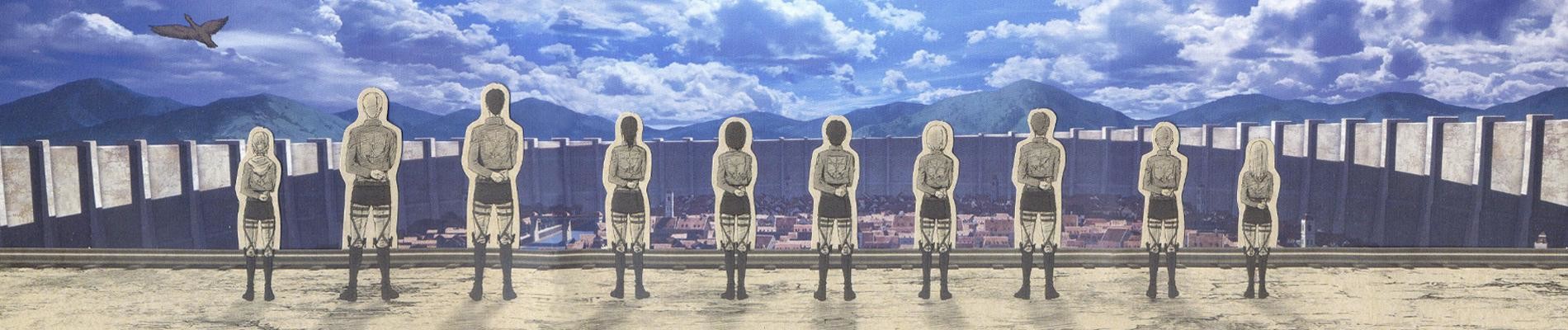

Time is generous to art that earns it. A year after the conclusion of Attack on Titan's final chapter special, the discourse has settled from the white-hot debates of premiere week into something more considered and, ultimately, more illuminating.
This is that considered review — an attempt to assess Attack on Titan not in the heat of moment but as a complete work, from the first glimpse of the colossal Titan over Wall Maria to the final, controversial image of what Eren Yeager's story leaves behind.
What Attack on Titan Was, At Its Best
For its first two seasons and substantial portions of the third, Attack on Titan was the closest anime had come to prestige television drama. Director Araki Tetsuro (Season 1-3) and the Production I.G./Wit Studio team built something that didn't feel like anime in the dismissive sense some viewers mean when they use that word — it felt like serious, ambitious storytelling that happened to be animated.
The central image of Season 1 — the breach of Wall Maria, the traumatic loss of Carla Yeager, young Eren's feral oath of revenge — established an emotional register of genuine grief and horror that the series returned to again and again. This wasn't a comfortable show. It was willing to kill characters the audience loved, to show violence that had consequences, to ask questions about freedom and sacrifice that didn't resolve into easy answers.
The Survey Corps expeditions, particularly the Female Titan arc, created a masterclass in sustained tension. Isayama Hajime's manga had established mysteries that seemed genuinely unanswerable, and the anime adaptation made them sing.
The Shift
Something changed around Season 3's second half, and the fandom has spent years arguing about exactly what and exactly when. Some place it at the Marley arc. Others at the final season's controversial trajectory for Eren himself.
What's clear in retrospect is that Attack on Titan was always building toward a story about cycles of violence, the perpetuation of hatred across generations, and the particular horror of watching an idealist become something monstrous. The question was whether the execution could honour the ambition.
The honest answer: sometimes yes, sometimes no.
The Final Chapter
MAPPA inherited the series under difficult circumstances — a compressed production timeline, massive fan expectations, and the challenge of adapting an ending that had already proved divisive in manga form. Their work on the Final Season is genuinely impressive technically, even if the production-schedule cracks are occasionally visible.
The final chapter special, split across two parts, handles the Rumbling sequence with spectacular visual ambition. The scale of the Titans' advance across the world, the desperate alliance between former enemies, and the emotional unraveling of Armin and Mikasa as they move toward the inevitable confrontation — all of this lands.
The ending itself remains contested. Eren's final conversation with Armin, his revelation about his true intentions, his acceptance of his role as the monster who makes others heroes — this is sophisticated, melancholy storytelling. It asks the audience to sit with ambiguity rather than resolution, to understand a character without forgiving him.
Some viewers find this unsatisfying. Others find it devastating in the best possible way. Both reactions are legitimate.
What It Leaves Behind
Attack on Titan changed anime. Not in the way that Evangelion or Cowboy Bebop changed it — as paradigm shifts in what the medium could do formally — but in the way it demonstrated that anime could be taken seriously by audiences and critics who had previously dismissed the medium.
The series generated a level of mainstream cultural engagement — academic essays, mainstream film reviews, literary analysis — that is unprecedented for a weekly television anime. It created a gateway for millions of viewers who now consider themselves genuine fans of the medium.
The series also demonstrated, for better and worse, what happens when a creator publicly constructs a thematic argument across a decade of storytelling and then must deliver on it. Not every element of the conclusion is earned. Some character arcs conclude abruptly. The Historia subplot, rich with implication in the middle seasons, is resolved offscreen in ways that feel dismissive.
But the argument at the heart of the series — that cycles of hatred perpetuate themselves, that the logic of revenge is indistinguishable from the evil it claims to oppose — is made with genuine force and artistic courage.
Final Assessment
Score: 9.2/10
Attack on Titan is one of the great achievements of 21st-century anime: ambitious in scope, serious in intent, technically extraordinary at its peaks, and willing to demand genuine intellectual and emotional engagement from its audience. Its flaws — an uneven final season pacing, some underdeveloped character resolutions — are real but do not diminish what it achieved.
Watch it. All of it. Then sit with it for a while.
Some stories deserve to be lived with rather than immediately judged.