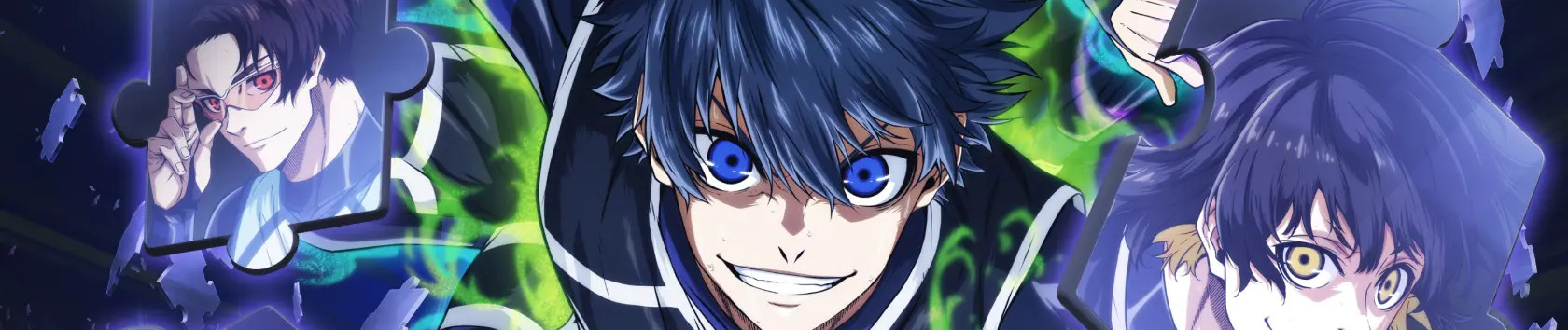

Every sports anime, for decades, has operated from the same foundational premise: the power of teamwork. The underdog team. The unlikely friendship. The recognition that you cannot achieve the highest level alone. Sports anime protagonists win because they bring out the best in those around them.
Blue Lock is the explicit, deliberate rejection of this premise.
The series begins with a radical assertion: the reason Japan has never produced a world-class striker is that Japanese football culture values selflessness over individual excellence. To produce the best striker in the world, you must create a program that strips away every instinct toward cooperation and replaces it with pure, self-directed ego.
Three hundred high school footballers enter the Blue Lock facility. All but one will be eliminated. The survivor will become Japan's ace striker. Everyone else goes home.
Isagi Yoichi and the Psychology of Winning
The protagonist Isagi Yoichi is not naturally gifted. His defining characteristic — spatial awareness, the ability to find the empty space on the pitch before it opens — is not a supernatural ability but a mode of attention, developed and refined under extreme competitive pressure.
What makes Isagi an exceptional sports anime protagonist is that his growth is psychological rather than physical. He does not get stronger or faster. He gets smarter — better at reading situations, better at understanding what he needs to do and why he needs to be the one to do it. His arc is about the development of predatory instinct in someone who begins as a genuinely nice person.
The series is honest about what this costs. The friendships Isagi makes in Blue Lock are real, but they are friendships between people who are also competing to destroy each other. The warmth is genuine and so is the predation. Both coexist without resolution because Blue Lock understands that elite sport actually works this way.
The Ego Concept
"Ego" in Blue Lock's terminology is not arrogance but the willingness to believe that you should be the one to score — that in the decisive moment, the correct decision is to take the shot rather than pass, to trust yourself rather than defer.
The series argues, through its plot mechanics, that this self-directed decision is what separates good players from great ones. The best striker is not the most selfless player. The best striker is the player who, in the moment before the chance appears, has already decided they will take it.
This is an uncomfortable thesis for a genre built on teamwork. Blue Lock commits to it completely, and the result is a sports anime that generates tension through intra-team conflict as much as through opposition. The scariest opponent Isagi faces are often his own teammates.
Bachira, Rin, and the Rival Dynamic
Meguru Bachira — Isagi's first genuine friend in Blue Lock, a player whose football is described as a "monster" that pursues the ball on instinct — is the series' most interesting supporting character. His arc is about distinguishing genuine talent from trained performance: is the monster real, or is it a story he tells himself?
Rin Itoshi — Isagi's primary rival, a generational talent whose technical ability exceeds everyone in the facility — is the series' best antagonist because his superiority is real. Isagi cannot defeat him through hard work alone. He must become something different.
The dynamics between these three characters carry the series' emotional weight as effectively as any conventional sports anime friendship.
The Animation
Eight Bit's production delivered something unexpected: football rendered with genuine tactical legibility. The sequences in which Isagi's spatial calculation is visualized — the heat map overlays, the trajectory predictions, the moment when the goal opens in his perception — are the most innovative sports anime visuals since Haikyuu!!'s server-receive sequences.
Season two, which moves into the U-20 international matches, escalated the animation quality further. The Neo Egoist League matches are the best the series has delivered.
What Blue Lock Means for the Genre
Blue Lock's commercial and critical success — it is now one of the best-selling sports manga in history — has already shifted the genre's center of gravity. Series that might previously have defaulted to teamwork-and-growth structures are now competing with Blue Lock's harder, more psychologically specific vision of athletic excellence.
Whether this is good for the genre is a separate question from whether Blue Lock itself is good. The answer to the second question is: yes, emphatically.
Score: 9/10
Keep Reading: Blue Lock Manga World Cup Arc — The Hype Is Justified · Haikyuu!! — Why It's Still the Greatest Sports Anime Ever · Top 10 Shonen Anime of All Time