The premise of Delicious in Dungeon sounds like a single-joke concept stretched to breaking point: a party of adventurers, broke and starving after a disastrous dungeon run, decides to survive by cooking and eating the monsters they kill.
Twenty-four episodes later, it has constructed one of the most sophisticated fantasy worlds in anime history, delivered one of the medium's great villainous arcs, and made an earnest argument about the relationship between life, death, consumption, and ecological balance that would not be out of place in a serious nature documentary.
It is also genuinely hilarious. The premise sustains.
The World of Kui Ryoko
What makes Delicious in Dungeon extraordinary begins with its world-building, which is dense, consistent, and entirely free of the usual fantasy-world sloppiness.
The dungeon is not a generic monster-infested maze but a genuine ecosystem. Monsters exist in food chains. Plants grow where dungeon light permits. Water flows according to geological logic. Kui Ryoko spent years developing the rules of this place before writing a single page of the manga, and the result is a setting where every new revelation feels earned rather than convenient.
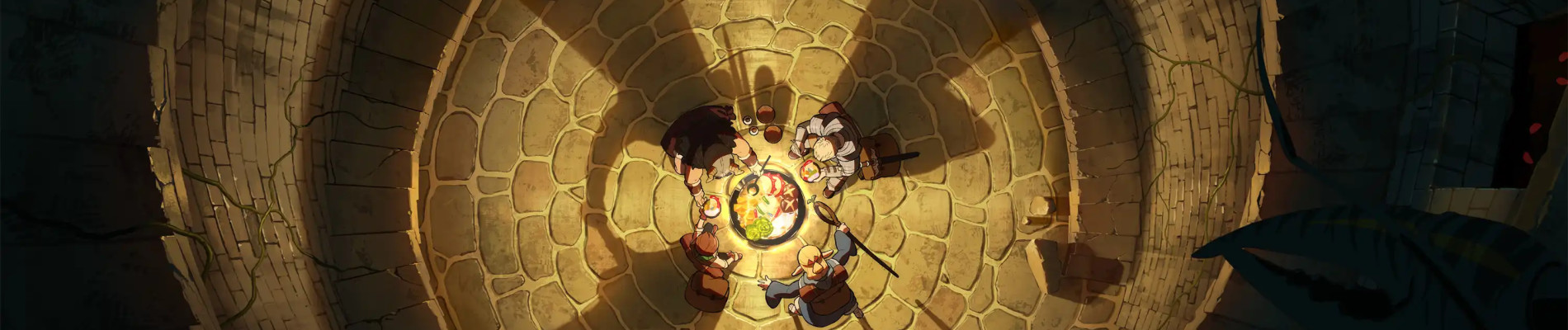
The food sequences — which appear in every episode — are the delivery mechanism for this world-building. When Laios's party cooks a slime, the preparation process teaches you what slimes are made of, how they survive, and what they mean for the dungeon ecosystem. The cooking show format becomes a vehicle for biological and ecological lore delivered with warmth and wit.
The Characters
Laios Touden is a protagonist whose primary characteristic — an obsessive fascination with monsters that transcends normal human social responses — would typically mark him as a comedy supporting character. Delicious in Dungeon gives him this role and then quietly reveals that his way of relating to the world, though unusual, represents a form of genuine engagement and empathy that the other characters are slowly learning from.
His sister Falin is the emotional engine of the plot — absent for most of the series, her rescue motivates everything, and when she finally appears in her transformed state she becomes the vehicle for the series' exploration of what it means for a body to be changed by what it has consumed.
Chilchuck the halfling lockpick is the show's funniest character and its most practically-minded — a working professional in a world of adventurers, bringing trade union sensibilities to the fantasy dungeon environment. His backstory, revealed late in the series, recontextualises his pragmatism as a specific response to specific grief.
Senshi the dwarf is the heart. The ancient, self-sufficient cook who has been living in the dungeon for decades, cooking every monster he kills, represents the show's central thesis in human form: life becomes meaningful when you approach it with complete presence and gratitude for what it offers.
Trigger's Production
Studio Trigger, typically associated with bombastic action and maximalist visual excess, has turned in here one of their most controlled and character-focused productions. The dungeon environments are rendered with unusual attention to texture and atmospheric light — stone feels cold and damp, fire feels warm, the transition between dungeon levels is a transition between ecosystems with distinct visual identities.
Character acting is particularly strong. The show's comedy relies on precise timing and subtle expression work rather than exaggerated reaction — Chilchuck's resigned face cycling through various stages of disbelief is one of the running gags of the year, and it works entirely through restraint.
The food animations are the production's signature achievement. Each cooking sequence is animated with the care typically reserved for action setpieces — mise en place, preparation technique, the physics of cooking rendered with genuine attention to culinary logic. Senshi's cooking is convincing as cooking.
The Second Half
Without spoiling specifics: the series' second half shifts register, moving from episodic adventure-cooking into a sustained examination of what happens when the dungeon's underlying power is invoked, and what it means for a person to be resurrected by consuming another.
This shift works because the world-building accumulated in the first half gives the dark turns genuine weight. The dungeon's ecological rules, which the cooking sequences made legible, become the basis for the central conflict's logic. The personal dimensions — Laios's relationship with his sister, Falin's relationship with her own body and will — pay off the character work done across twenty episodes.
Why It Matters
Delicious in Dungeon is an argument against waste and in favour of presence. Its central idea — that eating something fully and gratefully, understanding what it was and what it means for you to be sustained by it, is a form of respect rather than consumption — runs through every episode as both comedy and philosophy.
It is also just delightful. Funny, warm, beautifully made, generously paced. The rare series that asks you to pay attention to its world-building and rewards you for doing so.
Score: 10/10
Keep Reading: Best Anime of 2024: The Complete Year in Review · Frieren: Beyond Journey's End — Why It's a Masterpiece · Hidden Gem Anime of 2024 That Everyone Slept On