
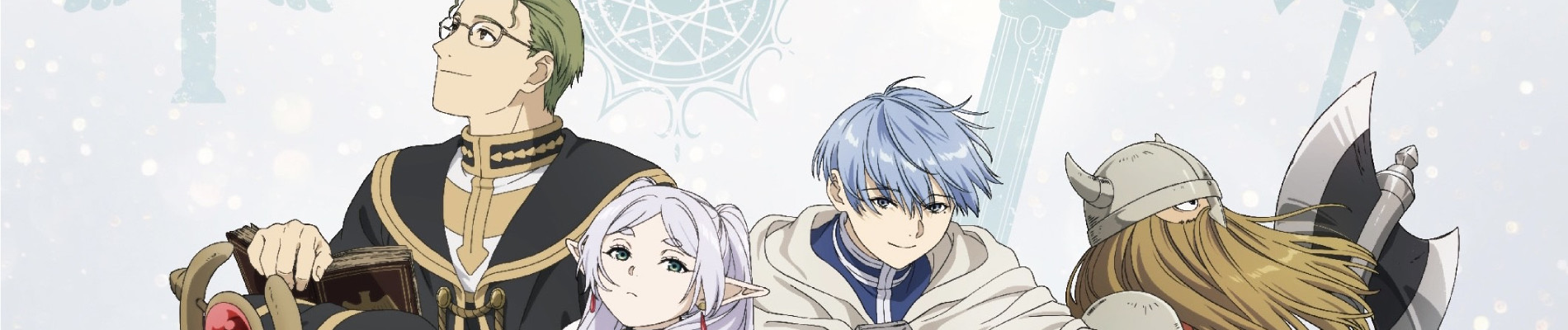
There is a scene in Frieren: Beyond Journey's End that does not involve a battle, a revelation, or a dramatic confrontation. It involves an elderly priest sitting quietly with an elf who has known him since he was a young man, watching him prepare to die peacefully after a full life.
The scene takes about two minutes. It does not announce itself as important. And yet, if you have been watching Frieren properly — if the story has been given its full due attention — you will find it almost unbearably moving.
This is what Frieren does. This is why it's a masterpiece.
The Premise
Frieren the elf mage was part of the legendary party that defeated the Demon King. Fifty years after that victory, her companion Himmel the Hero has died of old age — and Frieren, who spent those fifty years travelling and collecting spells, realises she barely knew him.
The series that follows is her journey to understand what it means to know someone. Accompanied by a young apprentice, Fern, and a veteran warrior, Stark, she travels through a world transformed by the Demon King's defeat, collecting memories and gradually opening herself to genuine connection.
What Makes It Different
Time as the Primary Subject
Most fantasy uses time as backdrop — the world has a history, events happened before the story begins. Frieren makes time itself the central subject. Because Frieren has existed for centuries and will exist for centuries more, every human relationship she forms is defined by the knowledge of its eventual end.
This creates a specific emotional quality unlike anything else in anime. The comedy of Frieren's social awkwardness (she spent a decade collecting a single spell and doesn't understand why humans think that's strange) sits alongside genuine grief — the grief of someone who has watched every person she loved die, and who has failed to be fully present for most of them.
The opening sequence — a ten-year time skip compressed into a single episode — establishes this register immediately. By the time Himmel dies, in the first episode, you feel the loss of someone you have known for ten minutes and fifty years simultaneously.
The Refusal of Urgency
Contemporary anime has been shaped by escalation mechanics. Stakes must continuously rise. Revelations must arrive before attention wanders. Frieren operates almost entirely against this momentum.
Episodes unfold with the patience of short stories, complete in themselves. A village asks Frieren to remove a curse that has persisted for a century. Fern learns to prepare tea to Frieren's particular specification. Stark confronts a dragon that humiliated him as a child.
These are small stories. They accumulate into something very large.
The Examination of Memory
Frieren's thesis is about what we remember and why, and how memory is the form love takes when its object is absent. The series returns repeatedly to Himmel — shown in flashback, glimpsed in statues the party passes along their original journey route — and the portrait that emerges is of a man Frieren has begun to understand only after losing the chance to know him.
This is about grief, specifically. Not grief as a plot event, but grief as an ongoing condition of existence for someone who outlives everyone they love.
The Production
Madhouse has delivered some of the most beautiful and cinematically composed anime of the last several years, but Frieren represents perhaps their greatest achievement. The landscape compositions — enormous natural vistas rendered with extraordinary attention to light and atmosphere — create a visual language for the passage of time and the smallness of individual lives within it.
Yuki Kajiura's score deserves particular attention. Working in a more restrained register than her typically operatic output, she produces something that functions almost as a meditation on silence — music that knows when to step back and allow the image to carry the weight.
The Mage Exams Arc
Some viewers found the extended Mage Exam arc — a departure from the episodic travel structure into a more conventional tournament format — a structural misstep. I disagree.
The arc is functioning as a character study for Fern and Stark at a point in the series where their relationship with Frieren has deepened to the point that new pressures are dramatically necessary. It also contains, in the confrontation with Serie, some of the series' sharpest dialogue about the nature of magical talent, effort, and the different relationships different people form with craft.
More importantly, it ends with the scene that conclusively demonstrates what the series has been building. I will not describe it here. If you have seen it, you know.
Is It the Greatest Anime Ever Made?
Some reviews have made this claim. It is a claim I want to handle carefully.
Frieren is extraordinary. It is the most emotionally sophisticated anime I have watched in at least a decade. It does things that no other anime does.
It is not Fullmetal Alchemist: Brotherhood in terms of scope or structural ambition. It is not Evangelion in terms of cultural impact or formal radicalism. Comparisons to those titles are about category, not quality.
What Frieren is, with certainty, is the most significant anime to examine how we live with impermanence — how we build meaning in relationships that will inevitably end, how we carry the people we've lost, and what it costs to finally let yourself be known by another person.
For that specific subject, treated with that specific care, nothing in the medium comes close.
Score: 10/10
Keep Reading: Best Anime of 2024: The Complete Year in Review · March Comes in Like a Lion — The Most Emotionally Honest Anime Ever · Top 10 Slice of Life Anime of All Time