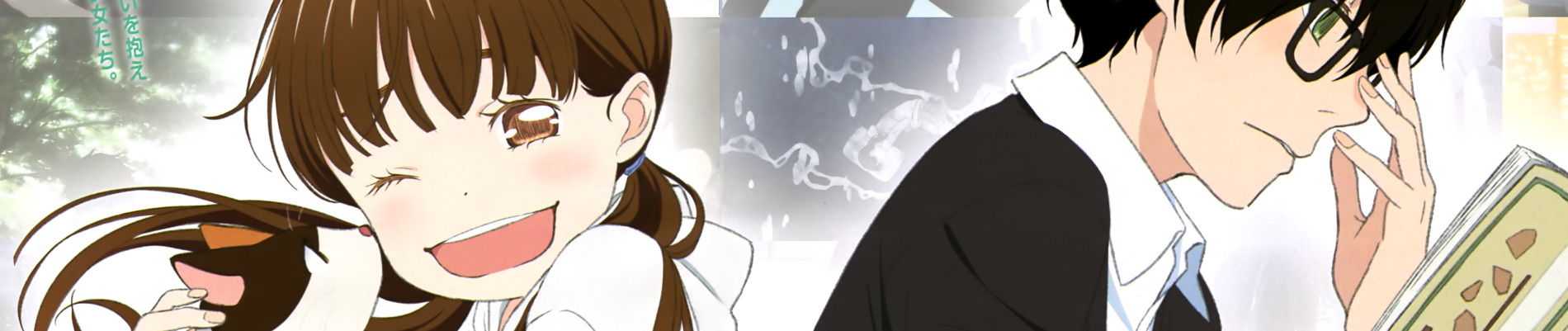
Rei Kiriyama is seventeen. He is one of the best shogi players in Japan. He lives alone in a small apartment. He eats convenience store food. He does not speak to anyone if he can avoid it.
In the first episode of March Comes in Like a Lion, he falls asleep on a train and misses his stop. Then he falls asleep again and misses it in the other direction. He sits in his empty apartment and thinks about the people he has failed. Then he eats a convenience store meal alone.
This is the texture of depression, rendered with unusual accuracy. And this is what March Comes in Like a Lion commits to for forty-four episodes before Rei finally, slowly, with real setbacks along the way, begins to be okay.
The Depression
Most anime that depicts loneliness or depression does so as a precondition — a state to be escaped so that the real story of connection and growth can begin. March Comes in Like a Lion is different. The depression is the subject. The slowness, the isolation, the particular exhaustion of existing without caring about your own existence — these are not obstacles on the way to the story. They are the story.
Shaft's production renders Rei's interior life through environmental metaphor — rising water, darkening rooms, the physical weight of his silences — but never in a way that aestheticizes the condition. This is not beautiful suffering. It is recognizable, specific, and treated with the seriousness it deserves.
The series is the most accurate depiction of depression in anime. I am aware that is a specific and defensible claim, and I am making it.
The Kawamoto Sisters
Everything changes, without announcement, when Rei accepts dinner from the Kawamoto family — three sisters who run a confectionery shop and who have their own losses and difficulties and who simply, without explanation, decide that Rei should eat properly and not be alone.
Akari, the eldest, feeds him. Hinata, the middle sister, befriends him with the uncomplicated directness of a thirteen-year-old who sees no reason not to. Momo, the youngest, treats his lap as a napping location of first resort.
The Kawamoto sisters are the series' answer to Rei's question of whether human connection is worth the risk of losing it. Their answer is given not in words but in repeated, ordinary actions: another meal, another invitation, another evening where someone notices he exists.
The series does not suggest that being adopted by a warm family cures depression. It suggests that being noticed consistently, over time, by people who are not going anywhere, is what makes recovery possible. That is a more honest answer.
The Shogi
March Comes in Like a Lion takes shogi seriously without requiring the audience to understand it. The matches are rendered as psychological encounters — we understand what it costs Rei to win, what it costs him to lose, and what the professionals he faces represent as obstacles and mirrors — without the specifics of the game mattering to the emotional dimension.
The series uses shogi as Rei uses it: as the one place where the turbulence of his interior life has rules and limits, where excellence is possible even when nothing else is.
The opponents he faces in season two are particularly well-drawn. Gotou, the player whose personal life intersects disastrously with Rei's — is the series' most complex antagonist. Their match is the best single sequence in either season.
Season 2 and the Bullying Arc
Season two introduces a sustained arc involving Hinata being bullied at school. The arc is difficult — not just because bullying is depicted with accuracy and without convenient resolution, but because the series uses it to examine what bystander culture produces, and how systems designed to manage conflict can function to protect perpetrators.
Rei's response to this — his decision to act on Hinata's behalf, in defiance of his instinct toward passivity — is the series' most significant single character moment. He is changed by what he does, and the series is honest about the cost of that change.
Shaft's Production
Akiyuki Shinbo and Shaft's visual language — unusual camera angles, typographic text, symbolic abstraction — risks becoming a distancing effect in wrong hands. Here, it serves the material precisely. The visual style is Rei's perception: a world processed through the particular distortion of depression, sometimes beautiful, sometimes oppressive, occasionally both simultaneously.
The Kawamoto sequences are rendered in warmer, more conventional animation — literally a different visual register, communicating the difference between how Rei experiences his isolated existence and how he experiences their company.
This is filmmaking. It is not incidental.
Verdict
March Comes in Like a Lion is the best slice of life anime ever made. Stronger claim: it is one of the ten best anime ever made in any genre. Its depiction of depression is accurate, its depiction of recovery is honest, and the Kawamoto sisters are among the greatest characters the medium has produced.
It is not easy to watch. It is worth every moment.
Score: 10/10